InMotion P6 Review: Inside the 93 MPH, $4,999 Electric Unicycle
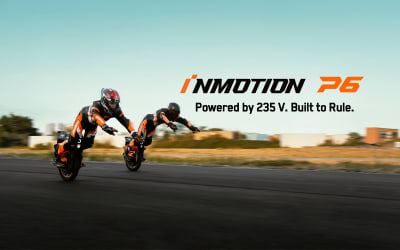
Search interest in "inmotion p6" has been climbing fast since launch, and the reason is a single number: INMOTION says the P6 is the fastest electric unicycle ever built, with an unrestricted top speed in the 90+ mph range. That is not a typo and not a theoretical lab figure — INMOTION built the P6 specifically to own that claim, and independent riders have already clocked it near 93 mph on a closed track. Most EUC coverage online still treats 35-40 km/h as "fast." The P6 is a different category of machine, and this review focuses on what that actually means for anyone deciding whether it belongs on their shortlist.
INMOTION positions the P6 as a halo performance wheel built on a new 235V platform, not an update to any of its commuter-focused lines like the V8 series. It ships in a base $4,999 configuration and a $5,999 P6+ bundle with extra accessories, and in the EU it retails around €5,199 through authorized resellers. At that price, the question is not whether the spec sheet is impressive — it clearly is — but who this wheel is actually built for.
INMOTION P6: Specs at a Glance
| Spec | INMOTION P6 |
|---|---|
| Motor | 6000W nominal, 20000W peak |
| Battery | 4200Wh, 235V, Samsung 21700-50S cells |
| Top speed | Up to 93 mph (150 km/h), tested |
| Range (manufacturer) | Up to 93 miles (150 km) |
| 0-30 mph acceleration | 1.9 seconds |
| Weight | 112 lb (51 kg) |
| Max load | 309 lb (140 kg) |
| Tire | 20 in, 80/90-14 |
| Suspension | 90mm hydraulic, dual-speed, adjustable |
| Max torque | 300 N·m |
| Water resistance | IPX6 (body), IPX7 (battery) |
| Charge time | 4 hours (5A), 80% in 1 hour (14A fast charger) |
| Price | $4,999 / $5,999 (P6+) US, ~€5,199 EU |
Every number on that table is built around one goal: a wheel that can sustain highway speeds without the motor, battery or frame becoming the limiting factor. That is a fundamentally different design brief from any commuter EUC, and it shows in every spec, not just the top line.
What a 235V Platform Actually Buys You
Most performance EUCs today, including the Nosfet Aero and similar mid-tier wheels, run on 100-130V platforms with 2000-3000W nominal motors. The P6's 235V system and 6000W nominal motor (20kW peak) are not an incremental step up — it is close to triple the voltage and double to triple the continuous power of a strong mid-tier wheel. That is what makes the 1.9-second 0-30 mph time possible, and why INMOTION rates peak output at 20000W rather than the 4000W figures typical of the mid-tier class.
Higher voltage at the same current draw means less heat and less voltage sag under hard acceleration, which is the real engineering reason sustained high speed is possible at all. A 100V wheel pushed toward 60+ km/h is typically fighting motor heat within minutes; the P6's platform is built to avoid that bottleneck, which is why riders have been able to sustain a tested top speed near 93 mph rather than touching it briefly before the system throttles back.
Suspension and the 51kg Trade-off
A wheel built to be stable at triple-digit speeds needs serious suspension, and the P6 delivers 90mm of hydraulic travel with dual-speed, adjustable damping — roughly 20mm more travel than the Nosfet Aero's 70mm setup, and tuned for high-speed stability rather than pothole absorption at city speeds. That suspension, combined with the 4200Wh battery pack, is also why the P6 weighs 51 kg (112 lb), more than double the Aero's 24.5 kg and over three times the INMOTION V8S's 16 kg.
That weight is not a flaw, it is the direct consequence of the spec sheet above it: you cannot fit a 4200Wh pack, a 20kW motor and 90mm of real suspension into a light wheel. Practically, the P6 is not something most riders carry up a flight of stairs or into an office — it is a wheel that lives in a garage or a van and gets transported to wherever it is actually going to be ridden hard.
Range and Charging on a 4200Wh Pack
INMOTION rates the P6 at up to 93 miles (150 km), and because the battery is roughly four times the size of the Nosfet Aero's 1110Wh pack, that figure is credible even allowing for the usual gap between manufacturer numbers and real-world riding — especially once a rider is actually using the performance the wheel is built for, rather than cruising at 25 km/h. Charging is a genuine strength: a 14A fast charger brings the pack to 80% in about an hour, a figure that would have been unrealistic for a battery this size a year or two ago. The standard 5A charger still covers a full charge in 4 hours.
Reviewers who have ridden the P6 are blunt about who it suits: this is a wheel for experienced, performance-focused riders, not a first EUC and not a commuter picked for its range figure.
Who the P6 Is Actually For
Three things make this a narrow-audience wheel rather than a broadly recommendable one:
- The acceleration and top speed are the entire point. A 1.9-second 0-30 mph time and a 93 mph ceiling are only assets to a rider who already has the balance, reaction time and track or closed-road access to use them safely. For anyone still building basic EUC skills, that performance ceiling is a liability, not a feature.
- The 51 kg weight rules out casual, carry-it-everywhere use. Riders shopping by portability, like someone choosing between the V8S and a commuter scooter, should look elsewhere entirely — the P6 is not competing in that category.
- The 140 kg max load and 300 N·m torque make it genuinely capable for larger or heavier riders who have been underserved by lighter performance wheels, which is a real advantage for that specific group.
Protective gear is not optional at this performance tier. A wheel capable of sustaining highway speeds demands a full-face helmet and real armor as baseline equipment, not an afterthought — the margin for error at 90+ mph is measured in inches, not seconds.
Price and Value
At $4,999 ($5,999 for the P6+ bundle) in the US and roughly €5,199 through EU resellers, the P6 costs more than double what the Nosfet Aero runs ($1,999 / €2,199), and over eight times the INMOTION V8S ($599). That gap is proportional to what is actually different under the hood — the battery alone is nearly four times larger than the Aero's — so the price is not disconnected from the spec sheet. It does mean the P6 is not a wheel to buy because it is INMOTION's newest model; it is a wheel to buy because a rider specifically needs the voltage platform and the sustained high-speed stability it was built around, and is prepared to ride and store a 51 kg machine accordingly.
The honest takeaway: the P6 is not an upgrade path for most EUC owners, it is a different machine built for a narrow, experienced, performance-focused audience. Riders shopping for a daily commuter, a first wheel, or even a capable all-rounder should look at the Nosfet Aero or INMOTION's own V8S instead — both solve very different problems at a fraction of the price and weight. For the smaller group of riders who actually want the fastest production EUC on the market and have the skill, storage space and closed-road access to use it responsibly, the P6 delivers exactly what its spec sheet promises, with no asterisks.