PEV for Delivery Couriers in Europe: Real Cost per 100 km vs a Car
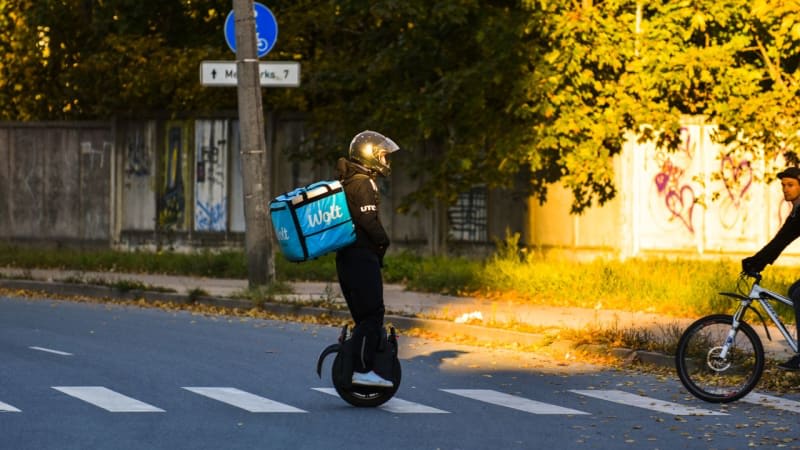
Food-delivery platforms such as Bolt Food and Wolt take couriers who have no car, and an e-bike or e-scooter is often the cheapest way to start. With petrol at €1.56–2.39 per litre across seven European countries, a car is the expensive way to do the same work.
This guide compares only the energy bill per 100 km for a petrol car, an e-bike, an e-scooter and an e-moped, then shows how little night tariffs and solar panels change the picture and which rules decide what you can actually ride. Platforms do not publish courier pay in the sources we found, so we do not estimate income.
Energy Cost per 100 km in Seven Countries
| Country | Petrol (€/l) | Home Power (€/kWh) | Petrol Car | E-Bike | E-Scooter | E-Moped |
|---|---|---|---|---|---|---|
| Lithuania | 1.951 | 0.216 | €14.63 | €0.22 | €0.39 | €1.41 |
| Poland | 1.560 | 0.300 | €11.70 | €0.30 | €0.54 | €1.95 |
| Germany | 2.179 | 0.362 | €16.34 | €0.36 | €0.65 | €2.35 |
| France | 2.229 | 0.249 | €16.72 | €0.25 | €0.45 | €1.62 |
| Spain | 1.780 | 0.251 | €13.35 | €0.25 | €0.45 | €1.63 |
| Italy | 2.016 | 0.314 | €15.12 | €0.31 | €0.57 | €2.04 |
| Netherlands | 2.391 | 0.244 | €17.93 | €0.24 | €0.44 | €1.59 |
How the numbers were built, so you can replace any of them with your own:
- Petrol price: Euro-super 95 from the European Commission Weekly Oil Bulletin, week of 19 October 2026.
- Power price: Eurostat household electricity, first half of 2026, taxes included, for annual use of 2,500–4,999 kWh. Smaller households can pay more per kWh.
- Car: 7.5 l/100 km. The Commission reports real-world consumption about 21 % above the official WLTP value for petrol cars registered in 2022; with a gap of 1.3 l/100 km that implies roughly 6.2 l official and 7.5 l real. City delivery is not easier than that average.
- E-bike: 1.0 kWh/100 km at the wall. The Ebike Monitoring Project averages 8.4 Wh/km over 30 bikes, with types ranging from about 6.8 to 20.5 Wh/km, plus about 10 % charging loss.
- E-scooter: 1.8 kWh/100 km. AkkuAlle averages 15.9 Wh/km over 31 models, calculated from battery capacity and rider-reported range, plus charging loss. These are not lab tests.
- E-moped: 6.5 kWh/100 km. Cenex measured 6.0 kWh from the socket for about 92 km on one electric scooter. One model only, so treat it as a rough guide.
- Not included: tires, maintenance, insurance, depreciation, parking.
What 100 km a Day Costs per Month
Assume 100 km on each of 22 working days, so 2,200 km a month.
- Lithuania: car about €322, e-bike €5, e-scooter €9, e-moped €31.
- Poland: car about €257, e-bike €7, e-scooter €12, e-moped €43.
- Germany: car about €360, e-bike €8, e-scooter €14, e-moped €52.
In our table the e-moped is about 6–11 times cheaper than the car per kilometre in energy, and the e-bike about 40–70 times cheaper.
Night Tariffs and Solar: Nice, Not Decisive
Time-of-day pricing exists in most of these countries, but the gap you can bank on differs a lot, and we only quote what we could verify:
- France: Tarif Bleu off-peak (8 hours a day) is €0.1589/kWh against €0.2142 at peak, in force from 1 August 2026 according to Selectra.
- United Kingdom: Octopus Go lists 8.5 p/kWh from 00:30 to 05:30 against about 30 p at peak, according to Heatable. The UK is outside the EU data above, so it is not in the table.
- Germany: the reduced night grid fee (Modul 3) averages about 2.26 ct/kWh against 7.39 ct standard, per ADAC. It is meant for controllable devices under §14a EnWG such as wallboxes and heat pumps and needs a smart meter, so a courier's plug-in charger is unlikely to qualify on its own. That is our reading.
- Poland: a Polish energy portal puts the G12 night zone at about 0.55–0.65 zł/kWh against up to 1.20–1.25 zł by day. It does not say whether the prices are gross.
- Spain: the cheap "valle" period is 00:00–08:00 on weekdays and all day at weekends and national holidays. We did not find a verified price gap.
- Italy: the F3 band covers 23:00–07:00 Monday to Saturday plus Sundays and holidays. We did not find a reliable 2026 price gap.
- Lithuania: night plans exist, but we could not verify current prices. Check your supplier.
The sums explain why this is a bonus and not the business case. An e-moped doing 100 km uses about 6.5 kWh. In France, charging all of it off-peak instead of at peak saves about €0.36 a day, roughly €8 a month. An e-bike that needs under 1 kWh saves cents.
Solar works the same way. A kWh from your own panels replaces the retail price you would pay, which is useful if you already have a system, but the saving is again counted in euros per month for a single PEV. Export rules and credits differ by country, so check yours before counting on it.
The real saving is avoiding the car: €11–18 of petrol per 100 km against €0.22–2.35 of electricity.
What Actually Limits a Courier PEV
- Legal class: in Germany a pedelec up to 25 km/h is treated as a bicycle with no licence, plate or insurance requirement. A speed pedelec up to 45 km/h is a small motorcycle: licence class AM, helmet, operating permit and insurance plate, and generally road only. Faster e-mopeds and L1e/L3e vehicles generally bring registration, insurance and a licence. See our guides on e-scooter rules in Europe and on L1e bikes on EU roads.
- Platform rules: Bolt Food in Lithuania lists "car, bike, or scooter" and says couriers keep up to 75 % of the fare with weekly payouts. Wolt in Lithuania accepts car, motorbike, e-bike and bicycle and does not mention e-scooters. Wolt couriers there register as self-employed with an individual activity certificate (code 532000) through Mano VMI.
- Who pays for what: platforms treat couriers as independent partners who are responsible for their own vehicle, according to an ERR report. Repairs, theft, insurance and a replacement battery are your cost.
- Range: 100 km at the average e-bike rate of 8.4 Wh/km needs about 840 Wh, and throttle-heavy riding can need more than double. Check the battery size, and plan a lunch-break charge or a spare pack.
- Speed: a 25 km/h cap on a legal e-bike is slower than a car or an e-moped in open traffic.
Which PEV Fits Which Courier
- Start with an e-bike if you have no vehicle and want the lowest running cost and the fewest legal steps. This is the cheapest way into delivery work.
- Consider an e-moped if your zone is spread out, you ride long shifts or you want more speed, and you accept registration, insurance and a licence.
- Check e-scooters carefully: rules differ by country and some platforms do not list them as an accepted vehicle.
Verdict
At current petrol prices a car costs about €12–18 per 100 km in energy, while a PEV costs €0.22–2.35. Night tariffs and solar help only at the margin. For a courier without a vehicle, the decisive questions are legal class, platform acceptance, battery range and who carries the repair and theft risk.
Sources
- European Commission Weekly Oil Bulletin, week of 19 October 2026, via fuel-prices.eu
- Eurostat, household electricity prices, nrg_pc_204, 2026 first half
- European Commission Climate Action: real-world CO2 emissions and fuel consumption of cars (OBFCM data)
- Ebike Monitoring Project, results page
- AkkuAlle: E-Scooter efficiency and electricity consumption 2026
- Cenex: real-world scooter performance study
- Selectra France: Heures Pleines and Heures Creuses
- Heatable UK: best EV tariffs 2026 (Octopus Go)
- ADAC: new grid fees (Netzentgelte) with a controllable wallbox or heat pump
- Globenergia.pl: electricity price 2026 and the G12 tariff
- Selectra Spain: tarifa 2.0TD
- ComparaSemplice: fasce orarie F1, F2, F3
- Upway: S-Pedelec rules in Germany
- Bolt Food Lithuania courier page
- Wolt Lithuania courier guide for new applicants
- ERR: couriers are independent partners responsible for their own vehicles